

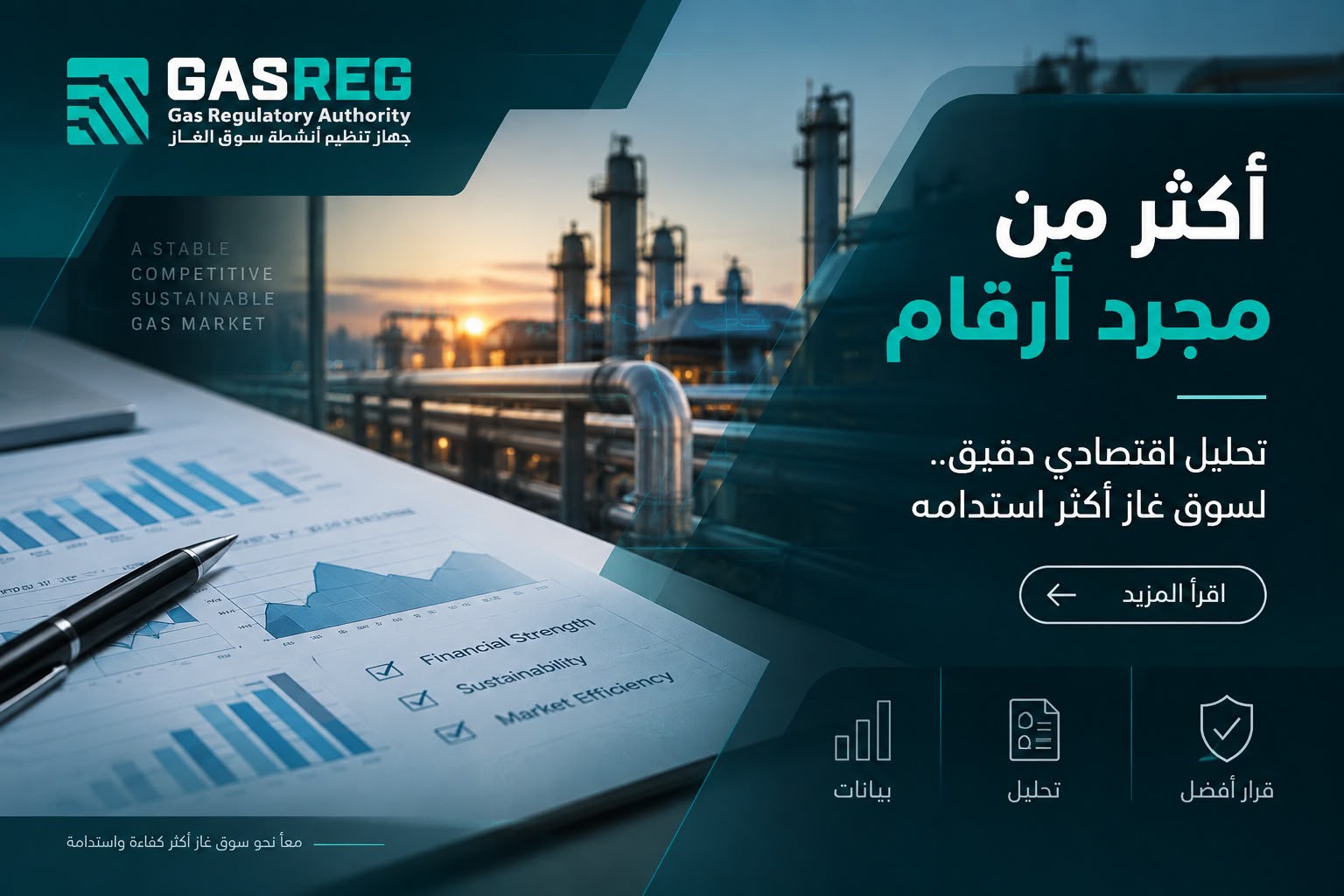
More Than Just Numbers.. GASREG Strengthens Its Integrated Approach to Assessing the Financial Soundness and Sustainability of Licensed Entities
The sustainability of activities in the natural gas market depends not only on the availability of adequate technical and operational capabilities, but also on the ability of market participants to meet their financial obligations and maintain efficient and sustainable operations.
Against this backdrop, the Gas Regulatory Authority (GASREG) applies an integrated approach to assessing the financial soundness and economic capacity of licensed entities. The assessment goes beyond reviewing financial statements or capital levels, incorporating a comprehensive analysis of financial performance, financing structures, liabilities, revenue generation, and current and future financing and investment requirements.
From Financial Statements to Understanding the Business
As part of its regulatory framework, GASREG currently applies integrated financial and economic analysis across approximately 35 active licenses, taking into consideration the nature and scale of each licensed activity.
The assessment covers a range of financial and operational indicators, including liquidity, debt levels, leverage, operating performance, turnover, break-even points, expansion and investment requirements, existing financing arrangements, and future funding needs.
The value of this assessment, however, lies not simply in calculating financial ratios, but in interpreting them within the broader context of each entity’s business model and operating environment. A high level of liquidity, for example, does not necessarily indicate greater efficiency, while a high level of debt does not automatically indicate financial weakness. The assessment therefore considers the overall financing structure, borrowing costs, cash-flow generation, liabilities, assets, and the current and expected scale of activities.
Assessing the Capacity for Growth, Not Only Continuity
GASREG’s approach also considers the entity’s ability to finance future plans, expansions, and investments, as well as its capacity to meet future financial obligations.
Each licensed entity represents a distinct economic case, requiring an assessment of its business model, sources of financing, financial indicators, cost and revenue structure, and investment requirements.
The assessment does not end with the issuance of a license. Financial and economic performance continues to be monitored by comparing actual results with forecasts and approved plans, while identifying trends or developments that may require further analysis.
Through this ongoing process, financial, economic, cost, revenue, pricing, and performance data are transformed into a broader knowledge base that supports a deeper understanding of market developments.
Accordingly, financial and economic assessment is evolving from a procedural step within the licensing process into a core tool of economic regulation, enabling risks to be better understood, measured, and analyzed, while ensuring that the financial and economic capacity of licensed entities remains appropriate to their activities, obligations, and ability to operate sustainably.
This approach contributes to strengthening market efficiency, financial resilience, and the long-term sustainability of Egypt’s natural gas market.