

GASREG Advances Capacity Management Framework Toward a More Flexible, Efficient and Sustainable Gas Supply System
Since its establishment under Gas Market Regulatory Law No. 196 of 2017, the Gas Regulatory Authority (GASREG) has been working to develop an integrated regulatory framework aimed at governing relationships among gas market participants, ensuring third-party access to gas networks and facilities, and maximizing the efficient use of infrastructure based on clear principles of transparency, neutrality, and efficiency.
Within this framework, GASREG has progressively developed the rules governing the management and use of capacity on the natural gas transmission network, moving toward an integrated capacity booking and management system that supports access to infrastructure by different market participants under clear and unified rules, while enhancing their ability to plan their capacity requirements more efficiently.
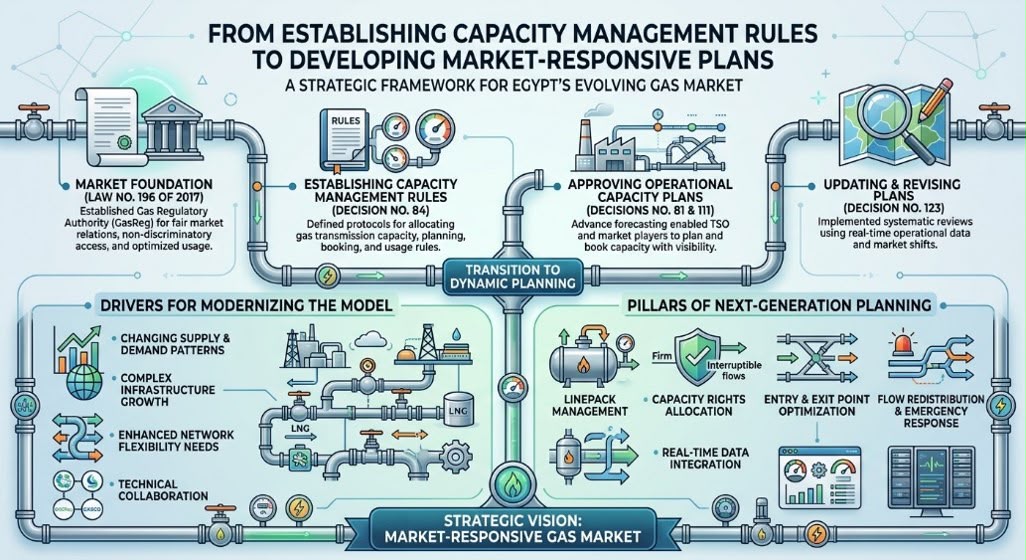
The development of the capacity management framework has gone through several key regulatory stages. It began with the establishment of capacity management rules and guidelines under Decision No. (84), which provided the regulatory foundation for managing available capacity on the gas transmission network and established the rules governing capacity planning, booking, and utilization.
This was followed by the approval of capacity plans under Decision No. (111), through which GASREG moved to a more advanced stage by determining capacity requirements and planned capacities in advance, enabling the network operator and market participants to plan based on a clearer outlook.
As part of the continued development of the framework, Decision No. (123) was issued concerning the approval of capacity plans, reflecting GASREG’s approach of continuously reviewing and updating capacity plans based on actual data and developments in the gas market.
These successive stages demonstrate the evolution of GASREG’s methodology—from establishing the rules governing capacity management, to implementing actual capacity plans, and subsequently reviewing and developing these plans in line with market requirements and technical and operational developments.
Why Does the Capacity Plan Need to Evolve?
With the rapid developments taking place in Egypt’s natural gas market, capacity planning is no longer simply a fixed estimate of required volumes. It has become a regulatory and technical tool that requires continuous review and updating in response to changes in supply and demand patterns, sources of supply, and network utilization.
The market is witnessing increasing developments in supply sources and a growing number of entry and exit points to and from the national natural gas network. This makes network flexibility, as well as its ability to redistribute flows and respond to unexpected changes in supply and demand, key factors that need to be considered when developing future capacity plans.
Against this backdrop, GASREG’s Technical Department has held meetings with the Egyptian Natural Gas Company (GASCO) to assess the currently approved capacity plan, examine its suitability in light of current and expected market developments, and explore the potential addition of new technical criteria and provisions that could contribute to more accurate and realistic estimates of required volumes and capacities.
Toward a New Generation of Capacity Plans
Through this development, GASREG seeks to gradually move from the concept of static capacity planning toward a more flexible and dynamic model. Such a model would not rely solely on estimates of expected volumes, but would also take into account the network’s ability to respond to multiple supply and demand scenarios and potential operational changes.
The key technical elements currently being considered as part of the capacity plan development methodology include:
* Network flexibility and Linepack management, enabling the system to respond to short-term variations between supply and consumption.
* Identification of firm and interruptible capacities, with clear priorities established in cases of constrained supply.
* Assessment of entry and exit point capacities and the potential use of alternative routes within the network.
* Redistribution of flows within the network in response to sudden changes in any supply source.
* Identification of emergency scenarios and mechanisms for addressing unexpected supply shortages.
* Greater reliance on actual operational data when preparing and reviewing planned volumes and capacities.
* Periodic review of the capacity plan to ensure its continued alignment with actual and anticipated market developments.

The cooperation with GASCO therefore represents more than a review of an existing capacity plan. It forms part of an ongoing process to develop the capacity management methodology, reflecting GASREG’s commitment to continuously updating its regulatory tools in line with actual technical and operational developments in Egypt’s natural gas market.
Capacity Planning in Response to the Market
This approach underscores that gas market regulation is a dynamic process requiring continuous development of the applicable regulatory frameworks and rules in line with changes in the market, infrastructure, consumption patterns, and supply sources.
Through continued cooperation between GASREG, the gas transmission network operator, and various market participants, the Authority seeks to establish a more accurate and flexible methodology for determining planned volumes and capacities. This methodology aims to balance market requirements with the technical capabilities of the network, support the optimal utilization of infrastructure, and maintain the security and stability of the natural gas supply system.
The development of the capacity management framework represents a continuation of the regulatory journey initiated by GASREG since its establishment. It demonstrates that the development of the gas market does not end with the establishment of rules and regulations, but continues through their review, assessment, and ongoing enhancement in response to the evolving market environment, strengthening infrastructure efficiency and its ability to respond to the requirements of the next phase.